What About the Breaker?
If you’re trying to determine why a particular receptacle is oriented differently, don’t assume you can figure it out simply by looking at it.
The circuit may have a specific purpose, or the electrician may have followed a particular installation convention.
If you’re curious about an outlet in your home, the safest approach is to check the home’s electrical documentation or have a qualified electrician inspect it.
Never remove the receptacle from the wall just to investigate.
Why Are Some Outlets Installed Sideways?
You may also encounter receptacles installed horizontally or in other orientations.
This can happen because of:
Space constraints
The design of the electrical box
The surrounding wall or cabinetry
A particular installation preference
Commercial or specialty applications
Again, orientation alone doesn’t tell you everything about the electrical circuit.
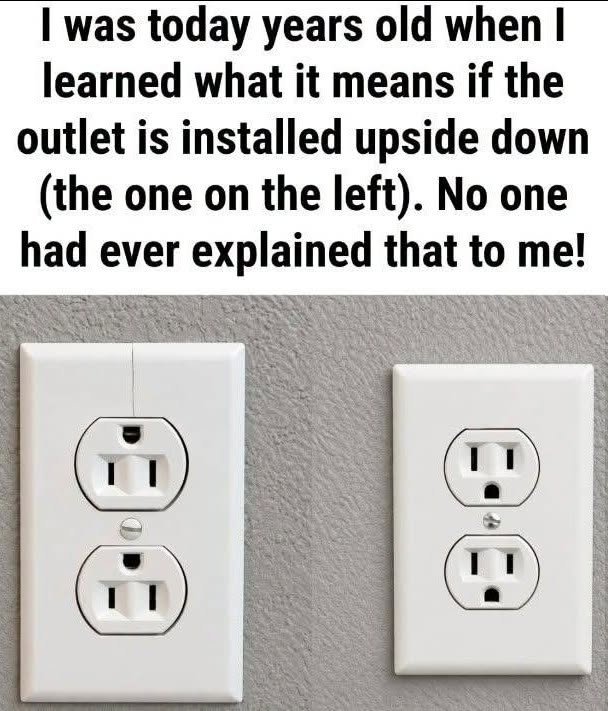
The “Ground Up” Debate
Electricians and homeowners have debated receptacle orientation for years.
One argument for ground-up installation is that if a plug becomes partially pulled from the receptacle and a conductive object lands across the exposed plug blades and the grounded metal portion, the configuration can potentially reduce the risk of a short circuit.
Another argument is that the traditional ground-down orientation is familiar and consistent with how most people expect receptacles to look.
There are legitimate practical considerations on both sides, which is one reason you may encounter both orientations.
Why You Shouldn’t Automatically “Fix” It
If you discover an upside-down receptacle, resist the temptation to turn it around simply because it looks unusual.
The orientation may have been intentional.
And changing a receptacle involves working with mains electricity, which can cause serious injury or death if handled improperly.
If you need to modify an outlet, have the work done by someone qualified and follow your local electrical requirements.
Frequently Asked Questions
Does an upside-down outlet mean it was installed incorrectly?
No. Receptacle orientation varies, and an upside-down appearance doesn’t by itself indicate an installation problem.
Is ground-up safer than ground-down?
There are safety arguments for both orientations. The appropriate installation depends on the application, local requirements, and the electrician’s installation practice.
Why do some electricians install outlets ground-up?
It may be chosen for safety considerations, equipment clearance, or as part of a particular installation convention. In some installations, orientation can also help distinguish circuits, but this isn’t a universal rule.
Should I turn my outlets around?
Not simply because they look different. If the receptacle works properly and there are no signs of damage, there may be no reason to change its orientation.
Does outlet orientation affect how electricity flows?
No. Turning a correctly wired receptacle around doesn’t reverse the electrical polarity. The electrical connections are determined by how the conductors are connected, not by which direction the receptacle faces.
The Bottom Line
An outlet that looks “upside down” isn’t necessarily upside down at all.
Electrical receptacles can be installed in different orientations for practical, safety, or installation-specific reasons. The direction the receptacle faces doesn’t by itself tell you whether the circuit is correctly wired or whether it’s a special type of outlet.
So the next time you notice one with the grounding opening at the top, don’t immediately assume an electrician made a mistake.
It may simply be a deliberate choice—and in some cases, that unusual orientation is there for a reason.
For Complete Cooking STEPS Please Head On Over To Next Page Or Open button (>)